- 27 May, 2026
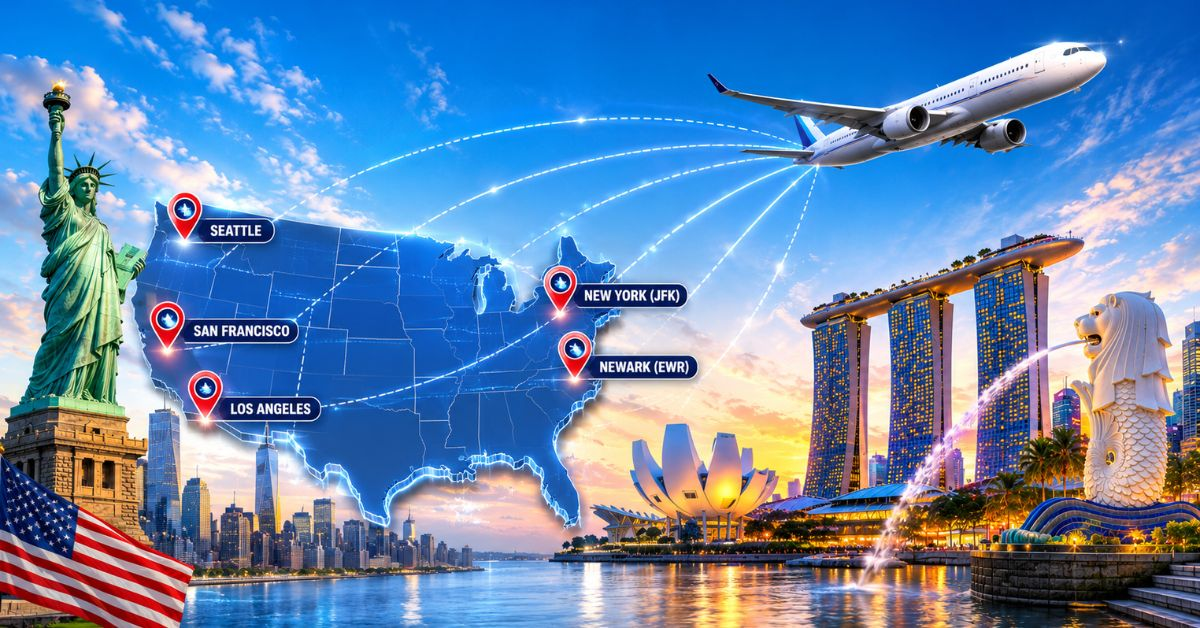
There's a reason seasoned long-haul travelers talk about Singapore's Changi Airport in the same breath as world wonders. The Jewel — a shimmering glass dome sheltering a 40-meter indoor waterfall — is just the welcome mat. Beyond it lies a city-state that punches absurdly above its size: a culinary capital, a business nerve center, a Southeast Asian launchpad. And yet, despite the distance — roughly 9,500 miles at its furthest from American soil — you can board a plane in five US cities today and wake up in Singapore without ever changing aircraft.
That's both a feat of modern engineering and a quiet commercial statement about how the US-Singapore corridor has matured. Here's an honest, city-by-city look at where those nonstop routes originate, who flies them, and what actually matters when you're booking one.
Why Nonstop Matters So Much on This Route:
On most international itineraries, a single layover is a minor inconvenience — an hour in Frankfurt, a transfer in Tokyo. On a US-to-Singapore journey, a connection can transform a 17-hour trip into a 24-hour ordeal. That's not a layover; that's a second day of travel. Every nonstop route listed below is genuinely worth the premium, if only for the compounding benefit of arriving with some coherence left in your body.
1. San Francisco: America's Most Frequent Gateway:
- Airlines: Singapore Airlines, United Airlines
- Daily Flights: 4 (combined)
- Aircraft: Airbus A350-900ULR (SQ), Boeing 787-9 (UA)
- Flight Time: ~17 hours 30 minutes
San Francisco International, SFO, is like the undisputed center of the US to Singapore traffic thing. Honestly, no other American city is anywhere near it when you look at plain raw frequency—there are four daily departures, so the whole connection basically works with most meeting schedules and every chronotype, more or less.
Two of those flights are from Singapore Airlines, using its Airbus A350-900ULR. The airplane is crafted for distance, not just “normal” range, so it has a built-in advantage. The other two are handled by United Airlines with its Boeing 787-9 Dreamliner. What’s neat is that these Star Alliance partners both fly the same city-pair, but they do it with rival aircraft designs. So SFO becomes a practical A/B test for long-haul cabin ideology, if you want to call it that.
Singapore Airlines and United? United launched the route, a full decade ago, back in 2016. At the time, its VP of Pacific Sales called it a “long-awaited service”, which is a phrase that basically signals it was overdue. Now fast forward ten years, and with Silicon Valley’s links to Singapore’s tech and fintech landscape only getting stronger, it still feels like one of the most commercially sensible transpacific routes still running.
Who should fly from here: Bay Area residents obviously, but also anyone connecting through SFO from Pacific Northwest or Southwest cities who values the depth of scheduling options.
2. New York (JFK): The Flight That Rewrote the Record Books
- Airline: Singapore Airlines
- Frequency: Daily
- Aircraft: Airbus A350-900ULR
- Flight Time: ~18 hours 55 minutes
Singapore Airlines flight SQ23 out of John F. Kennedy International is one of the longest commercial flights on earth. Nearly 19 hours up in the air, nonstop, crossing the Pacific in darkness, then landing at Changi in the late afternoon. It’s, by any honest measure, a physical test, but it’s also an extraordinary bit of logistics, made routine almost every day.
The A350-900ULR that runs this leg has a cabin setup that feels a little unusual: there is no economy class at all. The aircraft carries 161 passengers, spread across business class (67 seats) and premium economy (94 seats) only. This isn’t really a “save money” decision; it’s more of an engineering call. Ultra-long-range, twin-engine operations burn fuel in ways that only start to pencil out when every seat brings a higher yield. So in a slightly counterintuitive way, the longest flight in the world is also among its more premium experiences.
For New Yorkers with business or family ties in Southeast Asia, the JFK-Singapore nonstop does away with what used to be the mandatory stopover through Tokyo, Hong Kong, or Doha.
3. Newark: The World's Longest Scheduled Flight
- Airline: Singapore Airlines
- Frequency: Daily
- Aircraft: Airbus A350-900ULR
- Flight Time: ~19 hours 10 minutes
Newark Liberty International (EWR) sits just across the Hudson from Manhattan, but it has a little distinction that no other airport in the United States, or even the whole world, can really boast: it’s the place where the longest scheduled commercial flight that’s still operating today actually departs.
For example, Singapore Airlines flight SQ21 from Newark to Singapore is on the board for 19 hours and 10 minutes of block time. That figure also wraps in the taxi time at both ends, so the real time up in the air is a bit less, but it’s still a huge number. The trip back, Singapore to Newark, usually takes around 18 hours, often helped by favorable winds.
Just like the JFK side of things, SQ21 flies daily using the A350-900ULR, and it’s set up as premium-only. What makes the Newark service particularly interesting is the route itself: flights from the US East Coast to Singapore often go eastward over Europe and the Middle East on the outbound, then they swing westward over the Pacific on the return. So on the same round trip, passengers are basically flying in opposite directions around the Earth.
4. Los Angeles: The West Coast's Long-Haul Contender
- Airline: Singapore Airlines
- Frequency: ~10 flights per week
- Aircraft: Airbus A350-900 / A350-900ULR (seasonal)
- Flight Time: ~17 hours 20–50 minutes
Los Angeles has long been America's gateway to the Pacific, and the LAX-Singapore corridor reflects that geography well. Singapore Airlines operates around 10 weekly departures from Los Angeles International, making it the second-most frequent US departure point after San Francisco.
The flight is marginally shorter than the East Coast options — roughly 17.5 hours — because LA sits closer to the transpacific great circle route. Singapore Airlines operates the route primarily on its standard Airbus A350-900, with the A350-900ULR deployed seasonally. Practically speaking, the difference in passenger experience is minimal: both variants offer the same Business Class suites and premium economy products.
LA is also notable for being served by a one-stop option through Tokyo for those who prefer to break the journey — but given the city's Pacific Rim connectivity and the traveler profile, nonstop is overwhelmingly preferred.
Worth noting: Round-trip fares from LAX to Singapore can occasionally dip below $800, making this the most accessible nonstop option by price for budget-conscious travelers.
5. Seattle: The Quiet Achiever
- Airline: Singapore Airlines
- Frequency: 5 flights per week
- Aircraft: Airbus A350-900
- Flight Time: ~17 hours
Seattle-Tacoma International (SEA) is the least talked-about US gateway to Singapore, but it has been quietly serving the route since 2019. Singapore Airlines operates five weekly departures on the A350-900, and the load factors tell the real story: the airline filled over 91% of its Seattle seats in the 12 months to January 2026 — a figure that most carriers would celebrate on any route.
The geography works in Seattle's favor. The city sits at a high latitude, which trims the great circle distance to Singapore compared to LA or San Francisco. The result is one of the shorter westbound block times among US departure cities: around 17 hours.
Seattle's passenger base is also unusually well-matched to Singapore. Amazon, Boeing, Microsoft, and a dense ecosystem of tech startups create a steady flow of business travelers who move between the Pacific Northwest and Southeast Asia's commercial centers. The route, in that sense, isn't a gamble — it's a mirror of economic reality.
How to Choose Your Departure City
If you live near one of these five hubs, the choice is partly logistical. But for travelers with flexibility, a few principles hold:Frequency matters more than price if your schedule is tight. San Francisco's four daily departures give you the most rebooking flexibility. Newark and JFK offer one flight each day — miss it, and you're looking at a 24-hour delay.
The aircraft type matters on this specific route. Seventeen-plus hours in a seat that doesn't recline flat is genuinely uncomfortable. All Singapore Airlines flights on these routes use Business Class suites or premium economy — but on United's SFO service, the 787-9 product differs. Check seat maps before booking, not after.
East vs. West Coast routing affects which direction you circle the globe — and therefore your circadian rhythm on arrival. Westbound from LA or Seattle typically suits travelers adjusting to Singapore's SGT (UTC+8) more smoothly.
Conclusion
Five American cities. Two airlines. One city-state smaller than Los Angeles. The fact that Singapore sustains this level of direct connectivity from the US reflects something deeper than tourism: it's a trade and technology corridor, a financial hub with growing US investment, and — through Changi's onward connections — the most efficient transit point into Southeast Asia for the American traveler.Whether you're boarding a 19-hour marathon from Newark or a relative sprint from Seattle, you're taking part in one of commercial aviation's most impressive ongoing experiments in human endurance and engineering ambition. Pack your noise-canceling headphones. Choose your seat carefully. And remember: when you land, the waterfall is right there in the terminal.
Frequently Asked Questions(FAQ's)
Ans: Currently, you can fly nonstop to Singapore from San Francisco (SFO), New York (JFK), Newark (EWR), Los Angeles (LAX), and Seattle (SEA).
Ans: Nonstop flights are run by Singapore Airlines and United Airlines, depending on which city you're flying from.
Ans: San Francisco (SFO) has the most options — four daily nonstop flights, run by Singapore Airlines and United Airlines.
Ans: Among the nonstop cities, Los Angeles (LAX) sometimes has the cheapest round-trip fares, especially during sales or promotions.
Ans: The Newark (EWR) to Singapore route is the longest nonstop flight in the world, taking about 19 hours and 10 minutes.