- 12 Jun, 2025
Planning an international trip rarely goes the way you expect. You start with one simple question — where does this airline actually fly — and somehow end up thirty minutes later reading about Changi Airport's indoor waterfall, with zero flights booked and a browser full of tabs you'll never close. It happens to everyone.
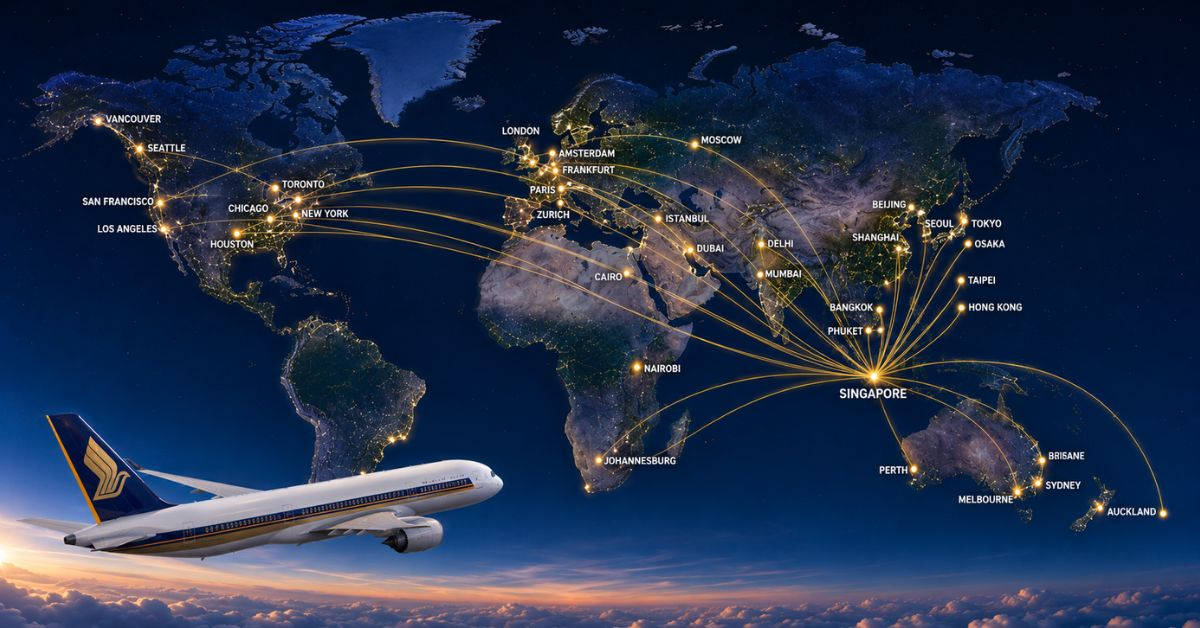
Singapore Airlines handles such situations more smoothly than many other carriers. Its home base — Singapore Changi Airport — sits at one of the more strategically placed spots on the global map — kind of roughly equidistant between Europe and Australia, and right in the center of Asia. That geography alone gives the airline a natural edge which most carriers can’t really mimic without building a hub in a much larger country.
So, to answer the question, “How many countries does Singapore Airlines fly to?” — as of June 2026, the mainline carrier covers 81 international destinations across 35 countries, more or less. If you factor in Scoot — the group’s budget airline — the total number jumps, to well over 120 destinations, together. Whether you're looking at a business class seat to London or a cheap fare to Bali, the same Singapore hub likely has something that works for you.
How Do Singapore Airlines and Scoot Routes Differ?
Same parent company, two very different products — and that distinction matters when you're actually planning a trip.
- Singapore Airlines (SQ):It is the full-service carrier, featuring iconic cabin crew uniforms, the lie-flat Business Class seats that feel almost too good, and the multi-course meals on long-haul flights. At present, Singapore Airlines flies to 81 international destinations across 35 countries covering major countries across Asia, Europe, North America, Australia, Africa, and the Middle East. These are mostly medium to long-haul routes, where a premium product really makes commercial sense.
- Scoot (TR): It serves a different kind of traveller completely. The major features of Scoot include budget pricing, in-depth regional connectivity, and destinations that a full-service carrier wouldn’t touch commercially such as secondary Indonesian cities, smaller Thai airports, and leisure places scross Asia-Pacific. Scoot, presently, reaches 84 international destinations across 18 countries, flying a mixed fleet of Boeing 787 Dreamliners, Airbus A320 family jets, and Embraer E190-E2 aircraft.
The two airlines aren’t in competition, more like they cover separate areas of the map As a combination they do it rather well. As already mentioned, the combined SIA Group network has over 120 destinations, which basically puts it among the largest airline systems that run out of Asia-Pacific.
Besides the two carriers themselves, Singapore Airlines codeshare agreements, plus the Star Alliance membership, sort of push the accessible network even more. You get hundreds of extra cities opened up via partner airlines, places neither SQ nor Scoot fly to directly. In practice, you can arrange a Scoot service from Singapore to a nearby destination, then slide into a Singapore Airlines long haul flight from Changi, and manage the full journey under one single booking. It’s a functional setup, and a lot of travelers who tried it once end up rerouting back through Singapore again.
Where Does Singapore Airlines Fly? A Regional Route Breakdown (2026)
Singapore Airlines operates one of the most extensive international networks globally, connecting Singapore with major commercial hubs, leisure destinations, and gateways across six continents. The following table gives an outline of the regions in which Singapore Airlines flies internationally as of 2026.
Singapore Airlines Network at a Glance
|
Region |
Destinations |
|
South Asia |
12 |
|
Southeast Asia |
17 |
|
Greater China |
10 |
|
Japan |
5 |
|
South Korea |
2 |
|
Oceania |
9 |
|
Europe |
15 |
|
North America |
6 |
|
Middle East |
2 |
|
Africa |
2 |
|
Total |
81 International Destinations |
Route counts are based on currently operated destinations, from Singapore, and they exclude codeshare-only points, and also any future announced routes.here are the detailed Information about International Routes below:
1. South Asia (12 Destinations)
India (8)
-
SIN → Delhi (DEL)
- SIN → Mumbai (BOM)
- SIN → Bengaluru (BLR)
- SIN → Chennai (MAA)
- SIN → Hyderabad (HYD)
- SIN → Kolkata (CCU)
- SIN → Kochi (COK)
- SIN → Ahmedabad (AMD)
Other South Asian Destinations (4)
- SIN → Colombo (CMB), Sri Lanka
- SIN → Dhaka (DAC), Bangladesh
- SIN → Kathmandu (KTM), Nepal
- SIN → Malé (MLE), Maldives
2. Southeast Asia (17 Destinations)
Thailand
-
SIN → Bangkok (BKK)
- SIN → Phuket (HKT)
Malaysia
- SIN → Kuala Lumpur (KUL)
- SIN → Penang (PEN)
Indonesia
- SIN → Jakarta (CGK)
- SIN → Bali/Denpasar (DPS)
- SIN → Surabaya (SUB)
- SIN → Medan (KNO)
Philippines
- SIN → Manila (MNL)
- SIN → Cebu (CEB)
Vietnam
- SIN → Ho Chi Minh City (SGN)
- SIN → Hanoi (HAN)
- SIN → Da Nang (DAD)
Cambodia
- SIN → Phnom Penh (PNH)
- SIN → Siem Reap (SAI)
Other Southeast Asia
- SIN → Yangon (RGN), Myanmar
- SIN → Bandar Seri Begawan (BWN), Brunei
3. Greater China (10 Destinations)
Mainland China (8)
-
SIN → Beijing (PEK)
- SIN → Beijing (Daxing) (PKX)
- SIN → Shanghai (PVG)
- SIN → Guangzhou (CAN)
- SIN → Shenzhen (SZX)
- SIN → Chengdu (TFU)
- SIN → Xiamen (XMN)
- SIN → Chongqing (CKG)
Special Administrative Regions & Taiwan (2)
- SIN → Hong Kong (HKG)
- SIN → Taipei (TPE)
4. Japan (5 Destinations)
- SIN → Tokyo Narita (NRT)
- SIN → Tokyo Haneda (HND)
- SIN → Osaka Kansai (KIX)
- SIN → Nagoya (NGO)
- SIN → Fukuoka (FUK)
5. South Korea (2 Destinations)
- SIN → Seoul Incheon (ICN)
- SIN → Busan (PUS)
6. Oceania (9 Destinations)
Australia (7)
- SIN → Sydney (SYD)
- SIN → Melbourne (MEL)
- SIN → Brisbane (BNE)
- SIN → Perth (PER)
- SIN → Adelaide (ADL)
- SIN → Cairns (CNS)
- SIN → Darwin (DRW)
New Zealand (2)
- SIN → Auckland (AKL)
- SIN → Christchurch (CHC)
7. Europe (15 Destinations)
United Kingdom
-
SIN → London Heathrow (LHR)
- SIN → London Gatwick (LGW)
- SIN → Manchester (MAN)
Germany
- SIN → Frankfurt (FRA)
- SIN → Munich (MUC)
Western Europe
- SIN → Paris (CDG)
- SIN → Amsterdam (AMS)
- SIN → Zurich (ZRH)
- SIN → Brussels (BRU)
- SIN → Copenhagen (CPH)
Southern Europe
- SIN → Milan (MXP)
- SIN → Rome (FCO)
- SIN → Barcelona (BCN)
Eastern Europe / Türkiye
- SIN → Istanbul (IST)
Upcoming European Expansion
- SIN → Madrid (MAD) via Barcelona (launching October 2026)
8. North America (6 Destinations)
United States (6)
- SIN → New York JFK (JFK)
- SIN → Newark (EWR)
- SIN → Los Angeles (LAX)
- SIN → San Francisco (SFO)
- SIN → Seattle (SEA)
- SIN → Houston (IAH)
9. Middle East (2 Destinations)
- SIN → Dubai (DXB), UAE
- SIN → Riyadh (RUH), Saudi Arabia
10. Africa (2 Destinations)
- SIN → Johannesburg (JNB), South Africa
- SIN → Cape Town (CPT), South Africa
Fifth-Freedom Routes
Singapore Airlines operates a few fifth-freedom routes too, so passengers can end up traveling between foreign countries on an SQ flight
|
Route |
|
Singapore → Frankfurt → New York JFK |
|
Singapore → Tokyo Narita → Los Angeles |
These routes are considered to be strategically important long-haul services in the airline networks for Singapore Airlines.
Codeshare and Partner Destinations
Beyond its own network, Singapore Airlines opens up access to more than 1,000 destinations worldwide. This works through the Star Alliance network and a few strategic airline associations. Key partners include:
- United Airlines
- Lufthansa
- Air Canada
- ANA
- Air New Zealand
- Turkish Airlines
- EVA Air
- SWISS
- Virgin Australia
- Alaska Airlines
Through these partnerships, travelers can connect smoothly to secondary cities across Europe, North America, South America, Africa and the Middle East.
Singapore Airlines Network Changes in 2026: New Routes, Frequency Increases, and Service Adjustments
Singapore Airlines isn’t exactly standing still this year. You’ve got new routes being introduced, some existing ones getting extra flight frequency, and a couple Middle East services that are still finding their footing. If you’re planning ahead — like really ahead — here’s what’s changing in practice and why it matters for you.
Madrid Is Back — After 22 Years
Ok, so this is really a big deal. From 26 October 2026, Singapore Airlines will run a five-times-weekly service out of Singapore to Barcelona, then continuing onward to Madrid — assuming the regulator gives their clearance. The plane is the Airbus A350-900, and Madrid ends up as the airline’s 15th European destination, it’s also their first come-back to the Spanish capital since 2004.
And no, Barcelona isn’t going away completely from the network. It just moves from being a final destination, to being a stopover on the way to Madrid. If you were already going to fly into Barcelona, you’ll still land there, it’s just that the next leg will be attached as a different segment on the same plane.
Manchester, Milan, and Munich All Getting More Flights
It’s pretty clear that European demand keeps climbing, and the updated schedules also shows this:
- Manchester goes from five weekly flights to a daily setup starting 13th July 2026. This should be good news for travellers in the north of England, who’ve had fairly limited choices compared with London.
- Milan also steps it up. It shifts from four weekly flights to daily service from 25th October 2026, so it becomes a lot more practical as a connection point for northern Italy.
- Then Munich expands to 10 weekly flights from 26th October 2026, giving southern Germany better coverage than it’s had for a while now.
London Is Getting More Seats Too
Beyond the frequency tweaks for Manchester, Singapore Airlines is also adding capacity across its wider London setup. The details about the aircraft and the exact timing may move around a bit as departure gets closer, so if London is part of your route, it’s a good idea to confirm straight with the airline for the newest openings, not just go by what’s showing a few months out.
Middle East: Facing Uncertainties
Things are least settled in right now in the Gulf region. Dubai has revised schedules, Riyadh's launch is late as launch has been pushed back from originally decided timeline, and Scoot's Jeddah service is still under review with no firm restart date.
But that doesn’t really make the Middle East any less important, it’s more like the entire aviation world in the region is still in a kind of transition mode. So if you’re thinking about going to Dubai , Riyadh, or Jeddah later in 2026 try to keep your plan a little flexible, and also double check the newest details before you lock in the tickets.
Transiting Through Singapore Changi Airport — What You Actually Need to Know
A lot of travelers who pass through Singapore Changi Airport will tell you the same sort of thing, the layover was one of the better parts of the trip, somehow. And it’s not just an accident. Changi has been ranking as one of the world’s best airports for years now, and it really does earn that reputation in ways that matter, especially when you’re stuck between flights for a few hours.
Which Terminal Will You Land In?
Singapore Airlines runs from Terminals 2 and 3 based on where you're heading. Whereas Scoot uses Terminal 1. The positive part however is that these terminals, except for Terminal 4, are linked inside the transit area — meaning no hassle with immigration or searching for buses to move around. Terminal 4 is separate and requires a shuttle ride, though this isn't an issue for most Singapore Airlines travelers.
How Much Time Should You Leave Between Flights?
Two hours is the bare minimum if your bags are already checked through all the way to your last stop and you’re staying with the same carrier. The moment you add even a little complexity — like picking up your luggage, swapping airlines, or doing the check in again — that number should jump to at least three hours atleast. Changi is fast and orderly but having a buffer, especially on international links, is always beneficial.
Do You Need a Visa Just to Transit?
Not for the vast majority of nationalities. As long as you're just in the airport transit area and don't go through immigration, you don't need a visa for Singapore. However, if you plan on leaving the airport during a layover, make sure to check the entry requirements for your passport first — they differ depending on which nationality you belong to.
Is a Long Layover at Changi Actually Worth It?
Honestly, yes — if you've got five hours or more. There are gardens, a cinema, sit-down restaurants, and plenty of retail across multiple terminals in the airport to keep you busy. If you’re eligible to step into Singapore during your layover, try to make some time for Jewel Changi Airport, it’s right there, linked straight to the terminals. Inside you’ll find the HSBC Rain Vortex, which is the world’s tallest indoor waterfall and honestly it’s unreal. Even if you’ve been there before, this kind of marvelous view just doesn’t really fade, there’s still that wow factor.
Why the Boeing 787-10 Matters on Singapore Airlines
Singapore Airlines functions with a fleet that is well-balanced. You can find — Airbus A350s and A380s, plus Boeing 777s and Boeing 787s — and the aircraft varies depending on the route. If you’re taking a medium haul trip out of Changi there’s a pretty good chance that you end up on a Boeing 787-10. For most people that’s decent news because the aircraft has a modern interior, comfortable seats, and a notably smooth ride which passengers often notice and appreciate.
Singapore Airlines operates more 787-10s than any other airline in the world. They've leaned into it heavily for regional and medium-haul flying — routes across Asia and down to Australia where the aircraft's range and efficiency make it a natural fit. Each one seats 337 passengers, split between 36 in Business Class and 301 in Economy.
What makes the 787-10 genuinely different from older wide-body aircraft isn't just the age — it's how the cabin actually feels. The windows are larger than you'd expect, the cabin pressure is set closer to sea level than most jets, and the humidity inside is noticeably higher. On a six to nine hour flight, those things add up. You land feeling less dried out, less headachy, and generally less like you've been recycling air in a metal tube for most of the day.
Routes where you're likely to board one include Bangkok, Bali, Manila, Osaka, Perth, and Fukuoka — so if any of those are on your itinerary, there's a reasonable chance you'll experience it firsthand without even looking for it.
The World Feels Closer When You Fly Singapore Airlines
Singapore Airlines network in 2026 is truly one of the strongest globally — and with new routes coming up, frequencies climbing, and Changi sitting right in the middle of it all, there’s rarely been a better moment to route through Singapore. Do check the newest timetables form official sources for your next travel plans particularly for the fresh European routes, and let Changi handle the rest.
Frequently Asked Questions(FAQ's)
Ans: As of June 2026, Singapore Airlines operates flights to 81 international destinations across 35 countries from its main hub, Singapore Changi Airport. When combined with Scoot, the Singapore Airlines Group serves more than 120 destinations worldwide.
Ans: India has the largest Singapore Airlines network in South Asia with eight destinations. Other countries with multiple destinations include Australia, China, Japan, Indonesia, Thailand, Malaysia, and the United Kingdom.
Ans: Yes. Singapore Airlines flies to six U.S. destinations: New York (JFK), Newark, Los Angeles, San Francisco, Seattle, and Houston. It also offers convenient onward connections to many other U.S. cities through its Star Alliance partners.
Ans: Singapore Airlines operates select fifth-freedom flights, including Frankfurt–New York (JFK) and Tokyo Narita–Los Angeles, allowing passengers to travel between two foreign countries on Singapore Airlines-operated aircraft.
Ans: Most international travelers do not need a visa as long as they remain within the airport's transit area. However, passengers planning to leave the airport during their layover should first check Singapore's entry requirements based on their nationality. The catch is, a visa will be required if you are transferring between (unconnected) low-cost flights or visiting Jewel Changi, as both require clearing immigration.
Ans: In 2026, Singapore Airlines is expanding its European network with the restructured Singapore–Barcelona–Madrid service, with Madrid becoming the new destination being added to Barcelona. The airline is also increasing flight frequencies to popular destinations, including Manchester, Milan, and Munich, to meet growing travel demand.
Ans: The Star Alliance network includes the following airlines: Aegean Airlines, Air Canada, Air China, Air India, Air New Zealand, All Nippon Airways (ANA), Asiana Airlines (leaving December 2026), Austrian Airlines, Avianca, Brussels Airlines, Copa Airlines, Croatia Airlines, Egyptair, Ethiopian Airlines, EVA Air, ITA Airways, LOT Polish Airlines, Lufthansa, Shenzhen Airlines, South African Airways, SWISS, TAP Air Portugal, Thai Airways, Turkish Airlines, United Airlines. Note: Star Alliance officially announced that Asiana will no longer be the part of the alliance and exit on 16 December 2026 to merge with SkyTeam member Korean Air.
Ans: Travelers choose Singapore Airlines for its on-time performance, innovative and unique inflight service, modern fleet and expansive global network. People choose this airline also because of its comfortable cabin products, generous baggage allowances, helpful staff, and loyalty programs like KrisFlyer.